

Implementing AI Agents in Logistics: A Practical Blueprint
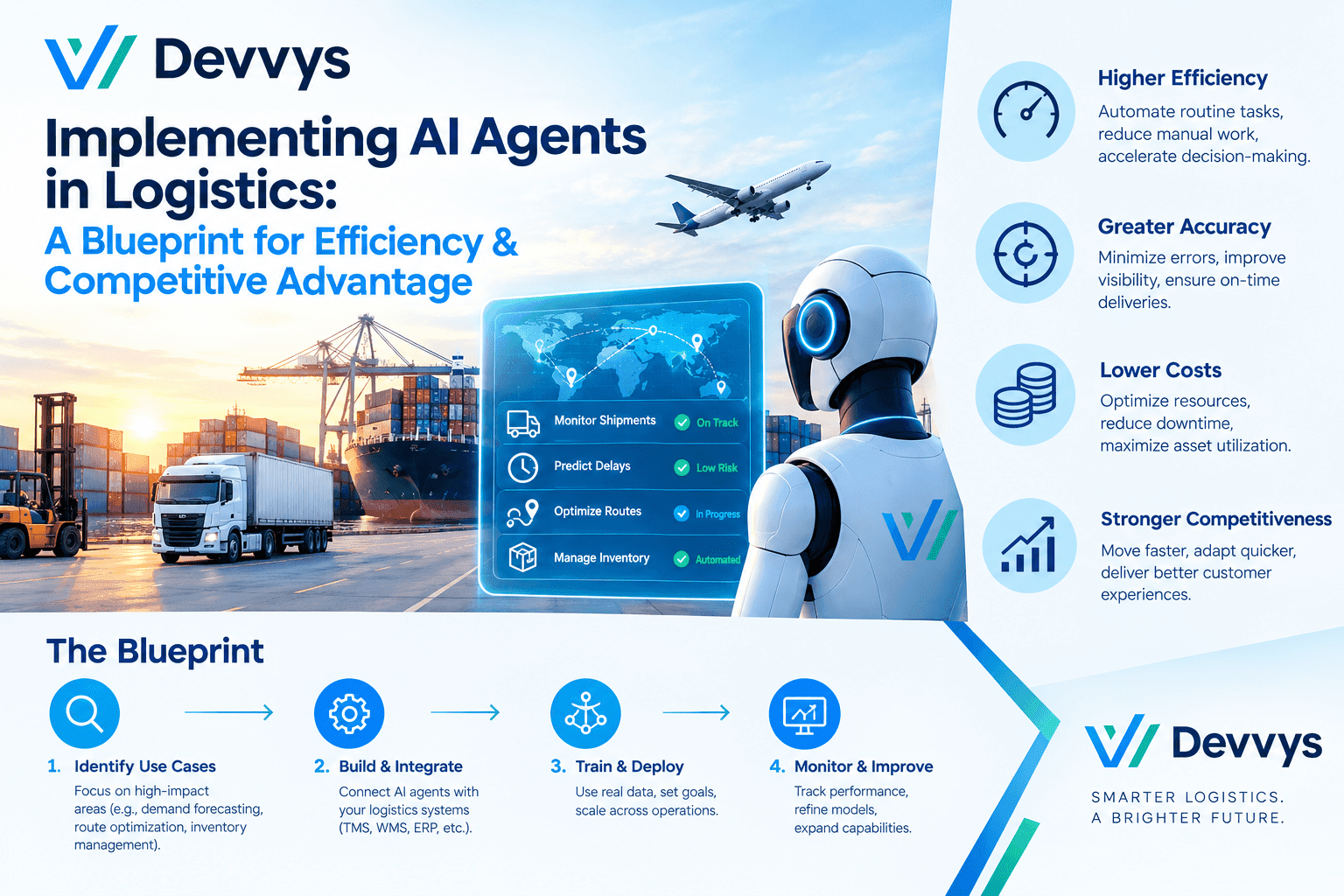
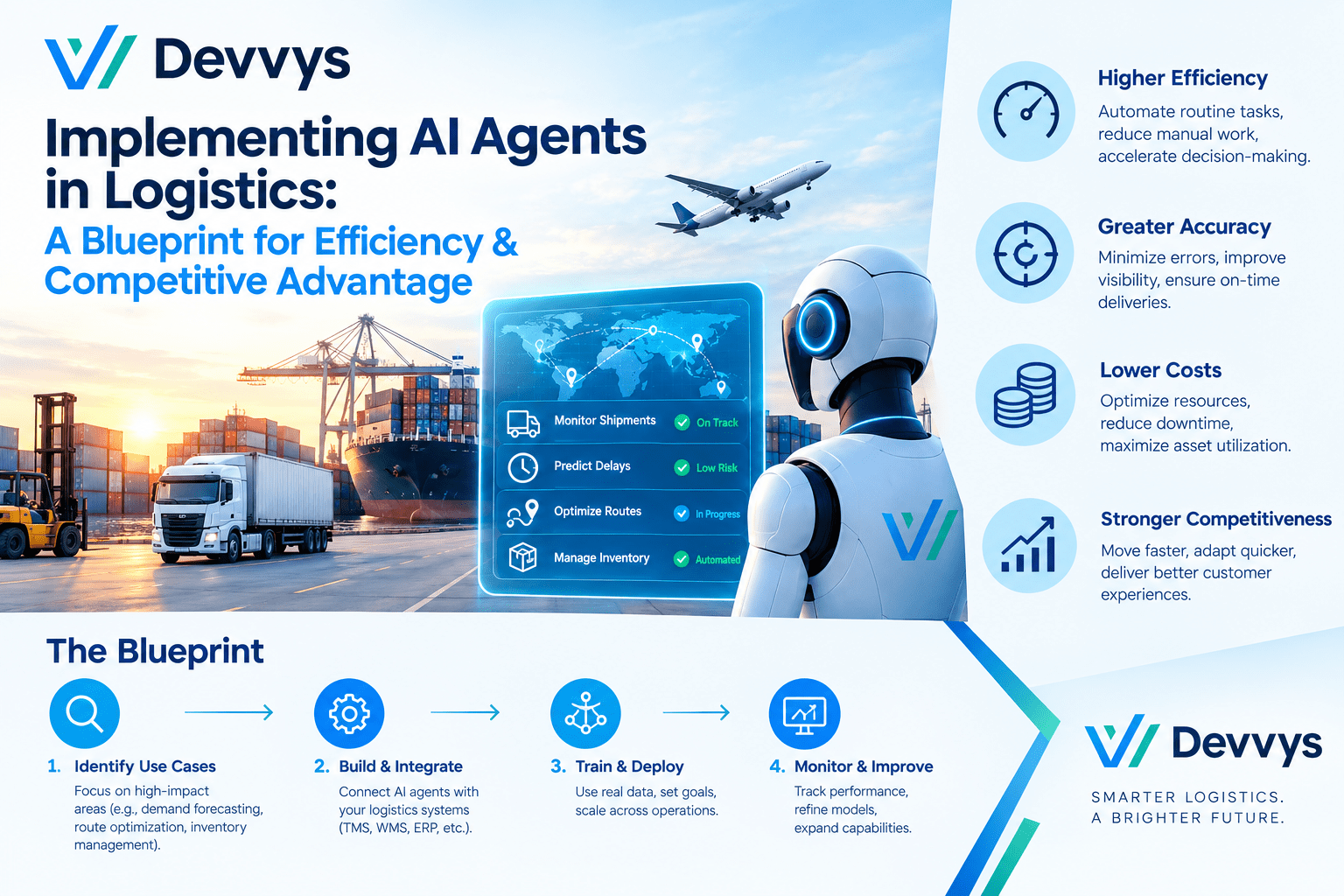
Implementing AI Agents in Logistics: A Blueprint for Efficiency & Competitive Advantage
Logistics teams make decisions under constant pressure. A delayed shipment can disrupt warehouse schedules, customer commitments, and transportation budgets. When information sits across disconnected systems, employees spend valuable time investigating problems instead of resolving them.
Implementing AI agents in logistics offers a way to connect information, decisions, and action. These systems can monitor operational conditions, evaluate alternatives, and execute approved tasks within defined limits. Success, however, requires more than deploying intelligent software. Businesses need reliable data, clear responsibilities, and a phased implementation strategy.
What Are AI Agents in Logistics?
AI agents in logistics are software systems that work toward defined operational goals using data, reasoning models, and connected tools. They can retrieve shipment information, investigate exceptions, recommend responses, and perform permitted actions across business applications.
Unlike a dashboard that displays information, an agent can help advance a workflow. For example, it might identify a delayed shipment, retrieve available alternatives, and prepare a revised delivery plan for dispatcher approval. Its authority should remain bounded by organizational policies.
How Agents Differ From Traditional Automation
Traditional automation typically follows predefined rules: when a specified event occurs, the system performs a corresponding action.
Agentic AI can evaluate context and select among available steps rather than follow one fixed sequence. This flexibility supports changing logistics conditions, but it also makes permissions, monitoring, and human oversight essential.
Where AI Agents Can Improve Logistics Operations
The strongest applications connect a recurring operational problem with a measurable outcome. Start with workflows where information gathering and coordination consume significant employee time.
Shipment Monitoring and Exception Management
Agents can monitor shipment events, identify potential disruptions, and retrieve supporting information from connected systems. Instead of requiring employees to investigate every update, they can prioritize exceptions needing attention.
For example, an agent could prepare a delay summary, identify affected customer orders, and recommend escalation. Automated communication should follow approved rules for accuracy, timing, and customer access.
Route Planning and Transportation Coordination
AI route optimization can support decisions about rerouting shipments when conditions change. An agent can coordinate the workflow by retrieving constraints, consulting routing tools, and presenting options to dispatchers.
The agent should not be confused with the optimization engine itself. Its role may be to connect specialized tools and operational systems, helping teams turn recommendations into controlled actions.
Inventory and Supply Chain Coordination
Agents can connect inventory conditions, shipment updates, and demand signals to support supply chain optimization. When incoming goods are delayed, they may identify affected operations and suggest adjustments.
This coordination helps teams evaluate responses across departments rather than optimize transportation in isolation. High-impact changes should remain subject to appropriate review.
A Step-by-Step Blueprint for Implementation
A practical AI logistics implementation strategy starts with business requirements and expands only after demonstrating dependable performance.
Step 1: Choose a Focused Business Problem
Select one manageable workflow, such as investigating shipment delays or answering internal freight-status requests. Avoid beginning with unrestricted, end-to-end autonomy.
Define the desired result before selecting technology. Examples include shorter investigation times, faster exception resolution, or fewer manual system lookups. Prioritizing bounded, measurable use cases creates a stronger foundation for expansion.
Step 2: Map the Existing Workflow
Document how employees currently complete the task. Identify systems consulted, decisions made, approvals required, and common failure points.
Then determine which steps an agent should assist, automate, or leave unchanged. Simplifying unnecessary process complexity before implementation prevents the business from automating an inefficient workflow.
Step 3: Prepare and Connect Operational Data
Effective logistics automation depends on accessible, trustworthy information. Relevant sources may include transportation platforms, warehouse systems, enterprise resource planning software, carrier feeds, and customer records.
Resolve inconsistent identifiers, missing events, and unclear data ownership. Establish which system provides the authoritative record for each decision. Weak data foundations can undermine even sophisticated agent capabilities.
Step 4: Define Tools, Permissions, and Boundaries
Specify exactly what the agent can read, recommend, and change. Access to shipment status does not automatically justify permission to modify bookings or approve additional spending.
Separate low-risk information retrieval from consequential actions. Require approvals for changes involving financial commitments, sensitive records, or important customer obligations. Maintain audit trails showing what happened and who authorized it.
Step 5: Pilot With Human Review
Test the agent on a limited workflow before expanding access. Initially, have employees review recommendations and verify proposed actions.
Evaluate normal operations alongside incomplete records, conflicting updates, unavailable systems, and unexpected requests. A successful pilot demonstrates not only useful outputs but also safe behavior when information is insufficient.
Step 6: Train Teams and Scale Gradually
Employees need to understand the agent’s purpose, limitations, escalation process, and approval requirements. Training should explain how responsibilities change, not merely how to use the interface.
Expand only after reviewing operational results and user feedback. Reassess permissions and support requirements whenever new workflows or integrations are introduced.
Measure Efficiency and Business Value
Improved logistics efficiency should be demonstrated through operational evidence, not the number of automated interactions.
Track measures relevant to the selected workflow, such as:
Average exception-resolution time.
Manual handling time per shipment.
Percentage of recommendations requiring correction.
On-time delivery performance.
Cost per completed transaction.
Unauthorized or failed action attempts.
Assign owners to monitor results and investigate deterioration. Agents should be evaluated against business goals and operational controls rather than activity alone.
Calculate the Full Cost of Implementation
Compare measurable benefits with development, integration, software, infrastructure, training, and ongoing support costs. Include the employee time required for supervision and exception handling.
A useful business case distinguishes potential savings from verified savings. Broader adoption should follow demonstrated value rather than assumptions that automation automatically improves profitability.
Manage Risks Without Blocking Progress
Predictive analytics in logistics and agent-driven workflows can improve decision support, but neither eliminates uncertainty. Missing information, inaccurate predictions, and poorly configured permissions can affect outcomes.
Maintain human escalation paths, monitor agent behavior, and preserve workable fallback procedures. Clear accountability is especially important when decisions affect customers, spending, or operational continuity.
Turn Implementation Into Competitive Advantage
Implementing AI agents in logistics creates a stronger operating model when it connects timely information with disciplined execution. The advantage comes from resolving problems consistently, coordinating teams effectively, and learning from measurable results.
Start with one valuable workflow, establish controls, and expand deliberately. Sustainable progress depends on combining capable technology with reliable processes and accountable people.