
How Google Ads Works: A Complete Beginner-Friendly Guide
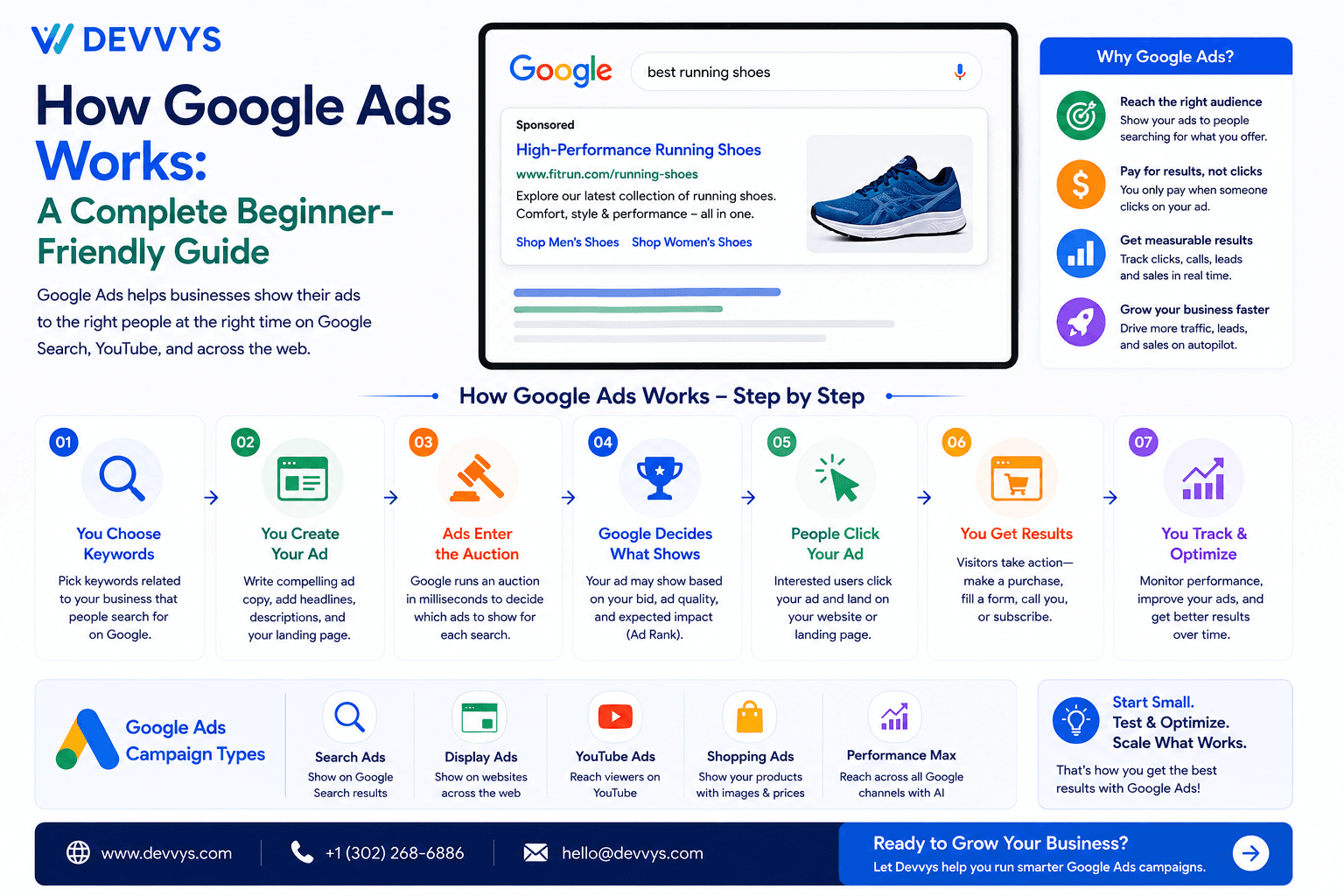
Google Ads is one of the most widely used online advertising platforms in the world. It allows businesses to reach people who are actively searching for products, services, or information related to what they offer. For many companies, it is one of the fastest ways to generate traffic, leads, and sales. But to use it effectively, you need to understand How Google Ads Works and what happens behind the scenes when a user types a search query.
At a basic level, Google Ads works by connecting advertisers with people who are looking for something specific. Businesses choose keywords, create ads, set budgets, and then compete in an auction when relevant searches happen. The ads that appear are determined by several factors, including bid amount, ad relevance, landing page experience, and expected performance. That means the highest bidder does not always win. Relevance and quality matter just as much.
This article explains the full process of how Google Ads works, including campaign types, keyword targeting, auction mechanics, costs, and optimization. If you are new to paid search, this guide will help you understand the system clearly.
What Google Ads Is
Google Ads is Google’s online advertising platform. It lets businesses display ads across Google Search, YouTube, websites, apps, Gmail, and other Google properties. The most common form is search advertising, where text ads appear above or below search results when users search for something relevant.
The platform is designed to help businesses show up at the exact moment people are interested. That timing makes Google Ads especially powerful because it reaches people with intent. Instead of interrupting them randomly, it connects with them when they are already looking for a solution.
Why Businesses Use Google Ads
Businesses use Google Ads because it can bring fast visibility, measurable results, and targeted traffic. It is especially useful for companies that want more leads or sales without waiting months for organic search results to grow.
Who Google Ads Helps
Google Ads can work for local businesses, ecommerce stores, service providers, startups, and large brands. Any business that wants to reach searchers with a specific intent can benefit from it.
How the Google Ads Auction Works
One of the most important parts of understanding How Google Ads Works is the auction system. Every time a user searches on Google, an auction decides which ads will appear and in what order.
Advertisers bid on keywords related to their business. When a search happens, Google checks the ads that match the query and evaluates several factors to determine which ones are shown. The auction is not only based on how much you are willing to pay. It also considers ad quality and relevance.
Key Auction Factors
Bid amount.
Ad relevance.
Expected click-through rate.
Landing page experience.
Ad assets and extensions.
Why the Auction Matters
A well-structured campaign can often outperform a larger competitor if it is more relevant and better optimized. That is why smart setup matters more than simply spending more.
Keywords and Search Intent
Keywords are the foundation of Google Search campaigns. Advertisers choose words and phrases that people are likely to type into Google. When those keywords match a user’s search, the ad may appear.
The best Google Ads campaigns focus on search intent. That means understanding what the user really wants. Someone searching for “best accountant near me” is likely close to hiring, while someone searching for “what does an accountant do” is still in research mode.
Types of Intent
Informational intent.
Commercial intent.
Transactional intent.
Local intent.
Why Intent Matters
The closer the keyword is to the user’s buying stage, the more likely the ad is to produce results. That is why businesses often focus on high-intent keywords first.
Campaigns, Ad Groups, and Ads
Google Ads is organized into campaigns, ad groups, and ads. This structure helps keep advertising organized and relevant.
A campaign sets the overall objective, budget, location, and campaign type. Inside each campaign are ad groups, which contain related keywords and ads. The ads themselves are the messages users see when they search.
Why Structure Is Important
A clean structure helps improve relevance. When ads and keywords are grouped properly, the campaign usually performs better and is easier to manage.
Example Structure
A dentist might have one campaign for emergency dentistry, one for cosmetic dentistry, and one for general checkups. Each ad group would focus on a narrower set of terms and ad messages.
Ad Rank and Quality Score
Ad Rank is what determines where your ad appears. It is based on your bid, the quality of your ads, the relevance of your keywords, and the user experience of your landing page.
Quality Score is Google’s way of measuring how useful and relevant your ad is. A higher Quality Score can help improve ad placement and lower cost per click.
What Affects Quality Score
Expected click-through rate.
Ad relevance.
Landing page experience.
Why This Matters
A well-optimized ad account can perform better and cost less than a poorly organized one, even if both businesses are bidding on the same keywords.
How Google Charges You
Most Google Ads campaigns use a pay-per-click model. That means you usually pay when someone clicks your ad, not when it simply appears. This makes it easier to track value because you are paying for interaction rather than just visibility.
Costs vary depending on keyword competition, industry, location, and ad quality. Some industries are more expensive than others because the value of the lead or sale is higher.
Why CPC Varies
Competition level.
Search intent.
Industry value.
Quality Score.
Location targeting.
Why Budget Control Matters
Google Ads allows advertisers to set budgets, but performance still depends on how efficiently the account is managed.
Landing Pages and Conversion
Clicks are only part of the equation. Once someone clicks the ad, they land on a page that should continue the message and make the next step easy.
A good landing page is relevant, fast, mobile-friendly, and focused on one clear action. If the page does not match the ad, the visitor may leave without converting.
Strong Landing Pages Include
Clear headline.
Relevant content.
Simple call to action.
Fast load time.
Mobile responsiveness.
Final Thoughts
Understanding How Google Ads Works helps businesses make better advertising decisions. Google Ads is not just about buying clicks. It is about combining keywords, ad relevance, bidding, quality, and landing page experience to reach the right customers at the right time.
When campaigns are set up well, Google Ads can be one of the most effective ways to grow a business. It gives you control, flexibility, and measurable results. That is why so many businesses rely on it as a core part of their digital marketing strategy.