

Custom Web Development Company Services, Benefits, and What to Expect
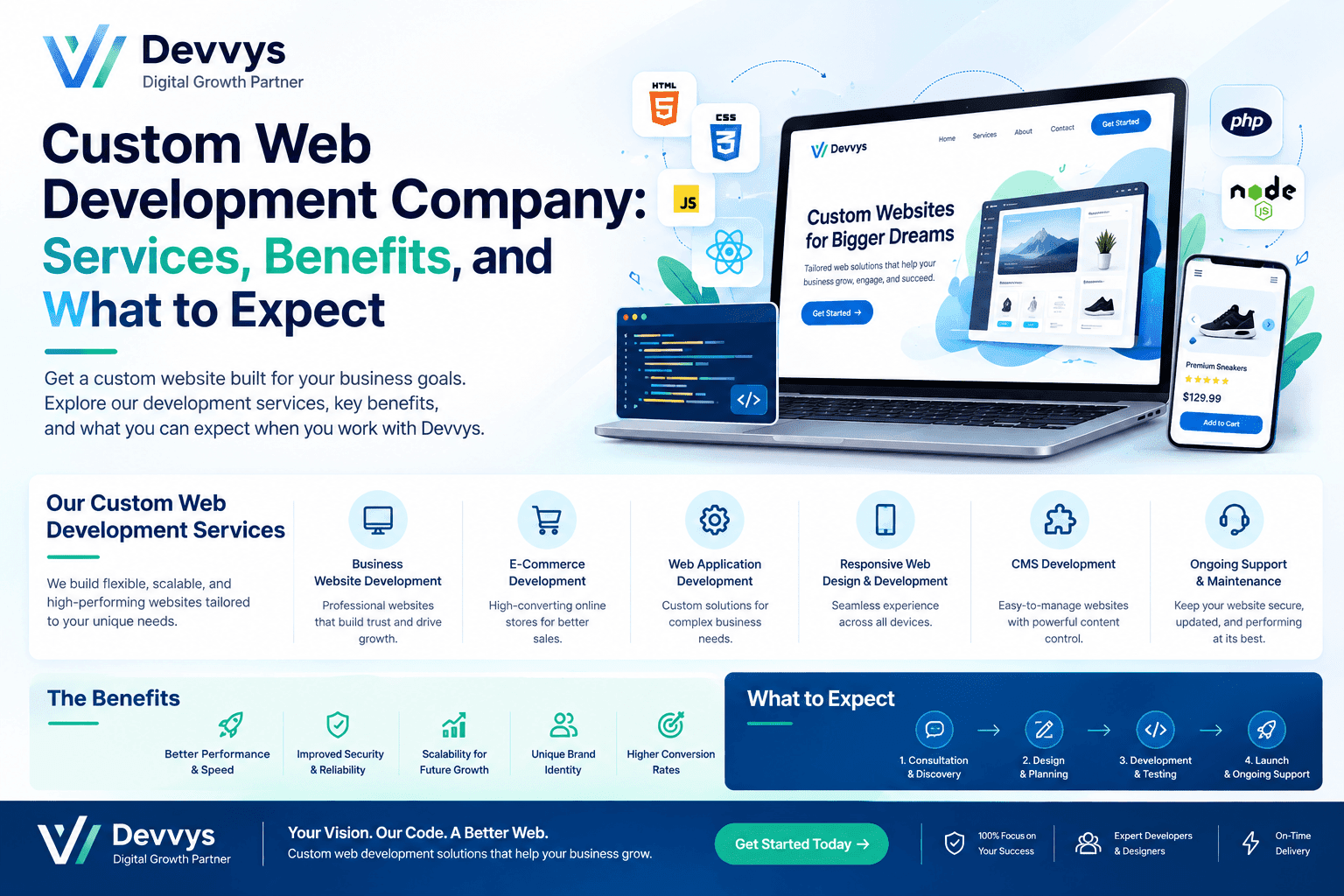
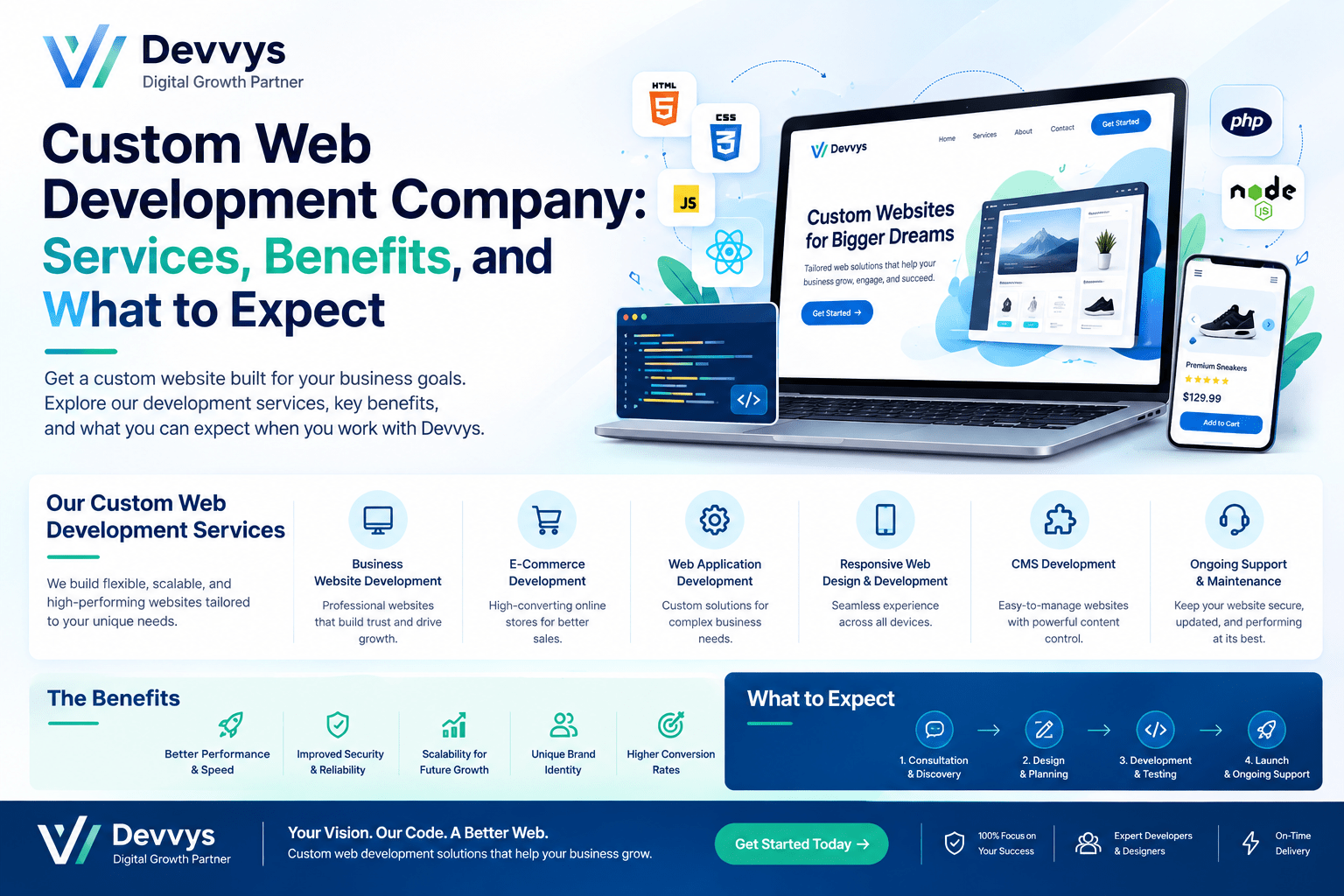
In 2026, a custom web development company builds tailored websites and web applications from the ground up to match your business processes, brand identity, and growth strategy instead of forcing you into prebuilt templates.
This guide explains what custom web development services include, why businesses choose them over template-based solutions, what to expect during the process, realistic costs and timelines, and how to select the right partner for your project.
What Is a Custom Web Development Company?
A custom web development company specializes in designing, building, and maintaining websites and web applications that are uniquely coded for your specific requirements rather than relying on off‑the‑shelf themes or website builders.
Unlike template-based builds, custom development gives you full ownership of the codebase, architecture, and integrations, allowing deeper control over performance, security, SEO, and scalability.
These companies typically offer end‑to‑end services: discovery and strategy, UX/UI design, front‑end and back‑end development, API integrations, QA/testing, deployment, and ongoing support and maintenance.
Custom Web Development Services: What's Typically Included?
Custom web development services vary by agency, but most reputable firms offer a core set of capabilities designed to support business goals beyond "just a website."
Core Custom Development Services
Custom Website Design & Development
Bespoke front‑end and back‑end builds using modern frameworks (e.g., React, Next.js, Vue, Laravel, Django, Node.js) tailored to your brand and functional needs.Ecommerce Development
Custom Shopify, WooCommerce, Magento/Adobe Commerce, or headless ecommerce solutions with unique checkout flows, product configurators, and integrations to ERP, inventory, and fulfillment systems.Web Application Development
Internal tools, customer portals, SaaS platforms, booking systems, dashboards, and workflow automation apps built around your actual operations.CMS Development & Customization
Tailored content management experiences (WordPress, headless CMS like Strapi/Sanity/Contentful, or fully custom admin panels) designed for your team's workflows.API Development & Third‑Party Integrations
REST/GraphQL APIs and integrations with CRM (HubSpot, Salesforce), ERP, payment gateways, identity providers, analytics, logistics, and legacy systems.Website Redesign & Migration
Rebuilding outdated sites with modern architecture, improved Core Web Vitals, better information architecture, and SEO‑friendly structures while preserving rankings through proper redirects and content mapping.Performance Optimization & Technical SEO
Speed tuning, image optimization, caching strategies, schema markup, clean URL structures, and server‑side rendering setups to improve rankings and conversions.Security Hardening & Compliance
Secure authentication, role‑based access, data encryption, regular patching, and alignment with standards like WCAG 2.2 AA and industry‑specific compliance needs.Ongoing Support & Maintenance
Retainers for updates, backups, monitoring, bug fixes, feature enhancements, and analytics‑driven optimization post‑launch.
Benefits of Working With a Custom Web Development Company
Choosing custom development over templates or generic builders delivers strategic advantages, especially for competitive industries, complex operations, or ambitious growth plans.
1. Full Control Over Architecture and Features
Custom sites are built around your business logic, not a theme's limitations. You decide the data models, user flows, and feature set from day one.
This is critical when your site must support unique products, multi‑step workflows, custom pricing rules, or specialized user roles that templates can't handle cleanly.
2. Superior Performance and Core Web Vitals
Without unnecessary plugins and bloated theme code, custom builds tend to load faster and score better on Core Web Vitals (LCP, FID/INP, CLS), which directly influence rankings and conversions.
Agencies focused on performance will optimize rendering paths, reduce JavaScript payloads, implement efficient caching, and choose hosting/CDN setups aligned with your audience geography.
3. Stronger Security Posture
Custom code isn't a mass‑market target like popular themes and plugins, which are frequently exploited at scale.
A good custom development company will implement secure authentication, input validation, least‑privilege access, regular dependency updates, and monitoring to reduce breach risk.
4. Seamless Integrations With Your Tech Stack
Instead of wrestling with limited plugin ecosystems, custom development allows direct API and webhook integrations with your CRM, ERP, payment processors, identity systems, analytics, and logistics platforms.
This creates a unified digital operations layer rather than isolated tools that don't talk to each other.
5. Scalability Without Re‑platforming
Template‑based sites often hit ceilings as traffic, product catalogs, or feature complexity grow, forcing costly re‑platforming later.
Custom architectures are designed to scale horizontally (more servers, microservices, headless setups) as your business expands, avoiding disruptive migrations down the line.
6. Unique Brand Experience and Differentiation
Custom design and development let you express your brand precisely across all devices and interaction states, rather than looking like dozens of competitors using the same theme.
For USA‑focused B2B and high‑ticket services especially, this differentiation impacts trust, perceived authority, and conversion rates.
7. Long‑Term Cost Efficiency for Complex Needs
While custom development has higher upfront costs, it can be cheaper over time than constantly patching, extending, and workarounding a template that wasn't built for your use case.
You also avoid paying for features you don't need and reduce reliance on multiple paid plugins with overlapping functionality.
Custom Web Development vs. Templates: When Does Custom Make Sense?
Understanding where custom development adds real value helps you avoid over‑engineering simple projects or under‑investing in critical ones.
When Templates May Be Enough
Simple brochure sites with standard pages (Home, About, Services, Contact)
Tight budgets and very short timelines
Minimal integrations and no complex workflows
You're comfortable living within a theme's design and feature constraints
Modern templates and visual builders have improved significantly and can match custom sites on speed and SEO if implemented well, especially for small businesses and local services.
When Custom Development Is the Better Choice
You need unique functionality (custom calculators, configurators, multi‑step applications)
Deep integrations with internal systems (ERP, inventory, custom databases)
High‑traffic, high‑conversion sites where performance directly impacts revenue
Complex ecommerce with non‑standard product types, pricing, or fulfillment logic
Long‑term scalability and ownership of code are strategic priorities
If your website is a core revenue driver or operational hub, custom development usually delivers more value over a 2–3 year horizon despite higher initial investment.
The Custom Web Development Process: Step‑by‑Step
Most professional custom web development companies follow a structured process to reduce risk, manage scope, and ensure alignment with business goals.
1. Discovery and Requirements Gathering
Duration: 1–2 weeks
This phase clarifies your business objectives, target audience, key user journeys, content needs, technical constraints, and success metrics.
Deliverables often include:
Problem statement and project goals
User personas and key scenarios
Feature list and prioritization (MVP vs. future phases)
Initial sitemap and content outline
A strong discovery prevents costly mid‑project changes and ensures the build solves real business problems, not just design problems.
2. Planning, Scope, and Architecture
Duration: 1–2 weeks
Here, the agency locks scope, budget, and timeline, and defines the technical architecture and tech stack.
Key activities:
Detailed scoping document and MVP definition
Information architecture and sitemap
Tech stack selection (front‑end, back‑end, CMS, hosting)
Security model and integration strategy
You should receive a clear roadmap showing phases, milestones, and dependencies.
3. UX/UI Design and Prototyping
Duration: 2–4 weeks
Design teams create wireframes and high‑fidelity mockups that map user flows, content hierarchy, and visual identity across devices.
Typical outputs:
Low‑fidelity wireframes for key pages and flows
Clickable prototypes to validate interactions
High‑fidelity UI designs aligned with your brand system
Design system or component library for consistency
This stage ensures the site is intuitive, on‑brand, and conversion‑focused before any code is written.
4. Development (Front‑End and Back‑End)
Duration: 4–12 weeks (varies by complexity)
Developers build the site in sprints, implementing designs, business logic, integrations, and CMS functionality.
Common practices:
Version control (Git) and code reviews
Regular sprint demos and feedback loops
Implementation of SEO‑friendly structures (clean URLs, schema, metadata)
Integration with APIs, payment gateways, and third‑party tools
For medium to complex projects, expect ongoing collaboration and iterative refinement rather than a "black box" build.
5. Quality Assurance and Testing
Duration: 1–2 weeks
QA teams verify functionality, performance, security, and cross‑browser/cross‑device compatibility before launch.
Testing typically covers:
Functional testing of all user flows
Performance testing (load times, Core Web Vitals targets)
Security checks and vulnerability scanning
Accessibility testing (WCAG 2.2 AA alignment where required)
Content and SEO checks (metadata, redirects, structured data)
Bugs and issues are logged, prioritized, and fixed prior to go‑live.
6. Deployment and Launch
Duration: ~1 week
The site is deployed to production hosting with proper DNS, SSL, CDN, and monitoring configured.
Launch activities often include:
Final content population and proofing
SEO migration (301 redirects, sitemap submission, Search Console setup)
Analytics and tag manager configuration
Backup and rollback plans in case of issues
A controlled launch minimizes downtime and protects existing search rankings.
7. Post‑Launch Support and Optimization
Duration: Ongoing
After launch, the focus shifts to monitoring, maintenance, and continuous improvement based on real user data.
Typical post‑launch services:
Bug fixes and security patches
Performance monitoring and tuning
A/B testing and CRO initiatives
Content updates and feature enhancements
Regular reporting on traffic, rankings, and conversions
This phase ensures your investment continues to deliver ROI as your business and market evolve.
What to Expect When Hiring a Custom Web Development Company
Knowing what a professional engagement looks like helps you set realistic expectations and avoid common pitfalls.
Communication and Collaboration
Expect:
A dedicated project manager or primary point of contact
Regular status meetings (often weekly 20–30 minute syncs)
Clear channels for feedback (email, Slack, project tools like Jira/Trello/Asana)
Transparent progress updates tied to milestones
Good agencies explain technical decisions in plain language and involve you in key choices rather than making assumptions.
Timelines and Milestones
Typical timelines (depending on complexity):
Simple custom sites: 6–10 weeks
Medium‑complexity sites/web apps: 3–6 months
Large enterprise platforms: 6–12+ months
Payments are often tied to milestones such as:
Discovery completion
Design approval
Mid‑development checkpoint
Pre‑launch QA sign‑off
Final launch and handover
Delays can occur if content, feedback, or decisions are slow on your side, so internal readiness matters.
Your Responsibilities as the Client
To keep the project on track, you'll typically need to:
Provide clear goals, brand assets, and existing content (or approve content plans)
Review and approve deliverables within agreed timeframes
Make timely decisions on scope, features, and design directions
Assign an internal stakeholder who can answer questions quickly
Agencies that can't clearly state what they need from you and when are a red flag.
Ownership, Access, and Handover
Before signing, confirm:
You will own the code, design files, and content upon final payment
You will have admin access to CMS, hosting, domain, and analytics
Documentation and training are provided for your team
There's a clear support and maintenance agreement post‑launch
Anything less can leave you dependent on the agency in ways that hurt long‑term flexibility and cost.
Custom Web Development Costs: What Influences Pricing?
Custom web development costs vary widely based on scope, complexity, integrations, and the agency's location and expertise.
Key Cost Drivers
Project complexity: Number of pages, custom features, and user flows
Integrations: CRM, ERP, payment systems, custom APIs, legacy systems
Design depth: Custom UX research, multiple concepts, advanced animations
Content needs: Copywriting, photography, video, multilingual support
Performance & security requirements: High‑traffic optimization, compliance needs
Agency profile: Boutique vs. mid‑size vs. enterprise‑grade firms, and their geographic base
Typical Price Ranges (Indicative)
While exact quotes depend on your brief, common ranges in 2026 look roughly like:
Simple custom brochure site: $5,000–$15,000
Medium‑complexity business site with CMS and some integrations: $15,000–$50,000
Custom ecommerce or web application: $40,000–$150,000+
Large enterprise platforms/SaaS: $150,000–$500,000+
Custom builds can cost 10–15× more than heavily customized templates, but capability differences are often only 2–3×, so it's important to validate the real need for full custom.
Always request a detailed proposal that breaks down assumptions, deliverables, exclusions, change‑order process, and total cost of ownership (including hosting, licenses, and maintenance).
How to Choose the Right Custom Web Development Company
Selecting the right partner is as important as the technology choices. A structured evaluation process reduces risk and improves outcomes.
Step 1: Define Your Project Clearly
Before contacting agencies, document:
Business goals and primary KPIs (leads, sales, sign‑ups, etc.)
Target audience and key user journeys
Must‑have features and nice‑to‑have features
Integration requirements (CRM, ERP, payments, etc.)
Budget range and ideal timeline
A clear brief allows agencies to give meaningful proposals instead of generic sales pitches.
Step 2: Shortlist Agencies With Relevant Experience
Look for:
Live sites they've shipped in the last 12–18 months (not just screenshots)
Projects in your industry or with similar functional needs
Case studies showing measurable outcomes (traffic, conversions, revenue impact)
Ask for 2–3 references and actually speak to past clients about communication, delivery, and post‑launch support.
Step 3: Evaluate Their Process and Thinking
In discovery conversations, assess:
The quality of questions they ask about your business and users
How they identify risks and propose phased approaches
Their explanation of tech stack choices and why they fit your case
Clarity around QA, security, deployment, and support
Teams that think critically and propose the smallest sensible first phase (e.g., paid discovery or MVP) are often safer bets than those pushing large, vague contracts.
Step 4: Compare Proposals Beyond Price
When reviewing proposals, compare:
Assumptions and scope clarity
Deliverables and acceptance criteria
Timeline feasibility and milestone structure
Ownership terms (code, design, accounts)
Post‑launch support model and costs
The cheapest option is rarely the best value if it cuts corners on discovery, QA, or long‑term maintainability.
Step 5: Run a Small Paid Discovery or Pilot (If Possible)
For larger projects, consider a paid discovery or small pilot phase to validate:
Communication style and responsiveness
Technical judgment and problem‑solving approach
Delivery cadence and documentation quality
Cultural fit with your team
This "test drive" can prevent costly mismatches before committing to a full build.
Key Questions to Ask a Custom Web Development Company
Use these questions during your selection process to uncover capabilities, risks, and fit.
Experience and Fit
Have you worked on projects in my industry or with similar goals? Can I see live examples?
What types of projects do you turn down, and why?
Who exactly will work on my project (roles, in‑house vs. subcontractors)?
Process and Project Management
Can you walk me through your development process from discovery to launch?
How do you handle scope changes mid‑project? Is there a formal change‑order process?
What will you need from us, and by when, to stay on schedule?
Technology, SEO, and Performance
What tech stack and CMS do you recommend for my project, and why?
How do you ensure the site is optimized for SEO and Core Web Vitals?
How do you approach security, backups, and ongoing maintenance?
Commercials and Ownership
What does the quote include/exclude? Are there recurring costs I should know about?
Who owns the code, design files, hosting, and licenses after launch?
What happens after launch? What support windows, bug‑fix policies, and rates apply?
Their answers will reveal whether they're a strategic partner or just a commodity dev shop.
Common Mistakes to Avoid When Working With a Custom Web Development Partner
Even with a good agency, certain client‑side mistakes can derail projects or reduce ROI.
Vague goals and requirements: Leading to scope creep, rework, and misaligned features.
Slow feedback and decision‑making: Causing timeline slippage and increased costs.
Ignoring content strategy: Resulting in beautiful designs with weak messaging and poor SEO.
Over‑customizing too early: Building complex features before validating core user needs and conversion paths.
No post‑launch plan: Launching without a clear roadmap for optimization, content updates, and maintenance.
Addressing these proactively improves the chances your custom site becomes a growth engine, not just a cost center.
Final Thoughts: Is a Custom Web Development Company Right for You?
A custom web development company makes the most sense when your website is central to your revenue, operations, or brand positioning, and when template‑based solutions would limit your ability to execute your strategy.
The benefits—full ownership, tailored architecture, better performance, stronger security, seamless integrations, and long‑term scalability—can outweigh the higher upfront investment, especially for USA‑focused B2B, ecommerce, and SaaS businesses.
By understanding the services offered, the typical process, realistic costs and timelines, and how to evaluate partners, you can make an informed decision and set your project up for success from day one.