

Business Development: Ultimate 2026 Guide to Strategies, Processes, and Sustainable Growth
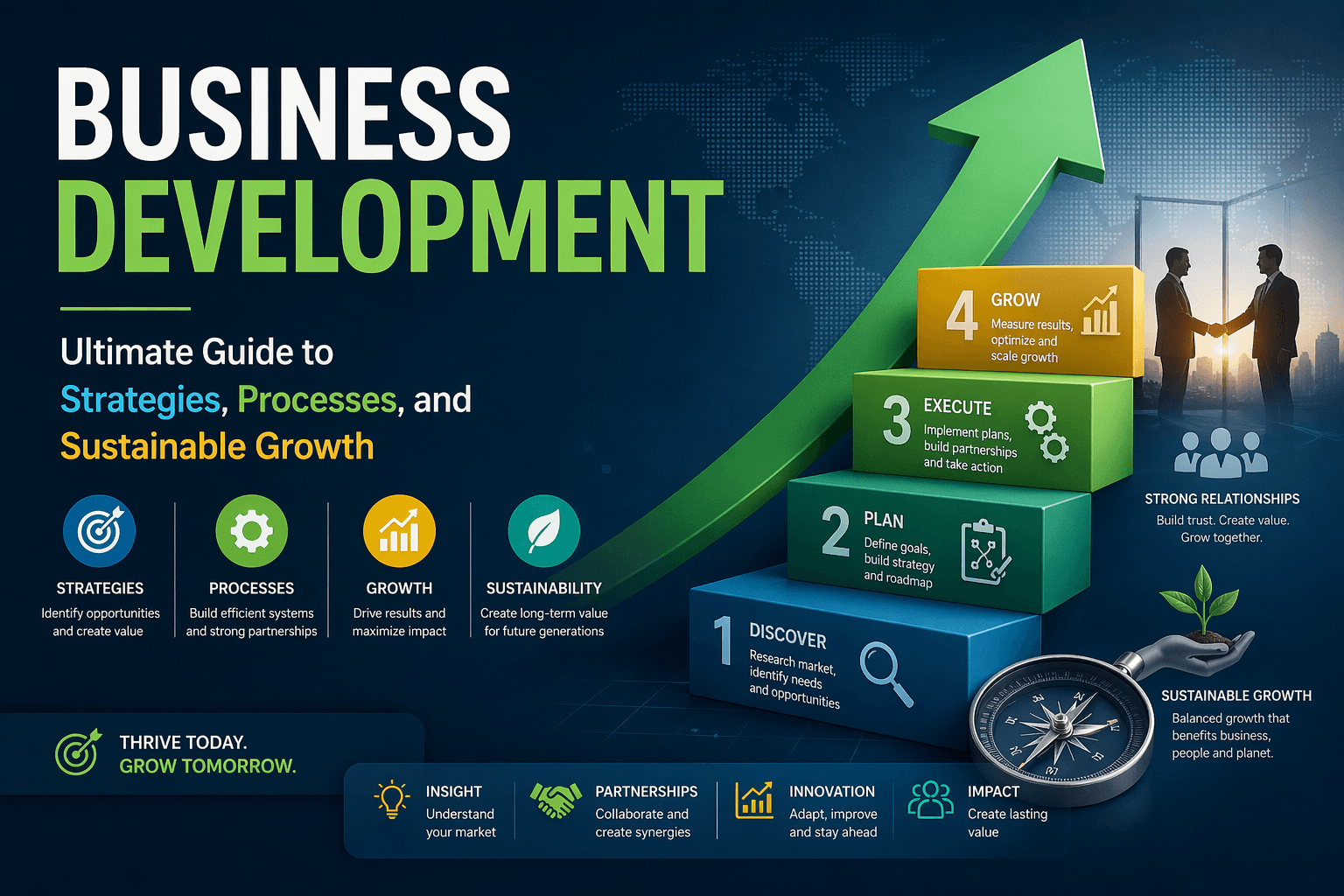
In today's fast-paced business landscape of 2026, mastering business development has become essential for sustainable growth and competitive advantage. Companies that prioritize strategic business development strategies often see revenue increases of up to 2.5 times compared to their peers, according to recent industry benchmarks. This comprehensive guide dives deep into what business development truly entails, why it matters for businesses of all sizes—from Karachi-based startups to global enterprises—and provides actionable steps, proven tactics, and real-world examples to help you implement effective business development processes right away. Whether you're a digital marketer optimizing for growth, a web developer building client pipelines, or an entrepreneur scaling e-commerce ventures, this 3000+ word resource equips you with everything needed to rank your business development efforts at the top.
What Is Business Development?
Business development is the strategic process of identifying growth opportunities, nurturing key relationships, and driving long-term revenue through innovative channels like partnerships, market expansion, and lead generation. Unlike sales, which focuses on closing immediate deals, business development emphasizes building foundations for sustained success, often overlapping with marketing but extending into operational strategy.
At its core, business development involves analyzing market trends, forging alliances, and creating value propositions that align with customer needs. For instance, a small e-commerce firm in Pakistan might use business development to partner with local logistics providers, expanding delivery reach without heavy capital investment. This holistic approach ensures not just short-term wins but scalable growth.
Core Definition and Scope
The scope of business development spans from prospecting new markets to optimizing existing ones, including activities like competitive research, RFP responses, and strategic negotiations. It's about creating mutually beneficial opportunities that fuel revenue streams, such as joint ventures or referral networks. In 2026, with AI tools enabling predictive analytics, the scope has broadened to include data-driven personalization at scale.
Business Development vs. Sales vs. Marketing
Sales teams chase quotas through direct pitches, while marketing builds brand awareness via content and ads. Business development bridges these by focusing on partnerships and ecosystem plays—think co-marketing agreements rather than one-off transactions. This distinction is crucial for small businesses, where resources are limited, making integrated business development strategies more efficient.
Evolution in 2026
Post-2025 economic shifts, including President Trump's reelection impacts on trade policies, business development has evolved toward digital-first tactics. AI-powered CRMs now predict lead quality, virtual reality networking events replace in-person conferences, and blockchain ensures transparent partnerships. Businesses ignoring this evolution risk stagnation in hyper-competitive markets like e-commerce and tech services.
Why Business Development Matters for Your Business
Effective business development directly correlates with revenue scalability and market resilience. Firms with robust strategies report 30-40% higher client retention and faster expansion into new verticals, making it indispensable for survival in 2026's volatile economy.
For solopreneurs and SMEs, it means turning limited networks into exponential growth engines; for enterprises, it optimizes massive pipelines for efficiency.
Impact on Revenue and Scalability
Strong business development practices can double revenue within 18 months by diversifying income sources. Case in point: a Karachi digital agency grew from 5 to 50 clients by systematizing outreach, proving scalability even in regional markets.
Role in Small Businesses and Enterprises
Small businesses benefit from low-cost tactics like LinkedIn networking, while enterprises leverage enterprise-grade tools for global reach. In Pakistan's gig economy, freelancers use business development to secure recurring PPC and SEO contracts, mirroring enterprise models on a micro scale.
Keyword-Rich Business Development Strategies That Rank
Top-ranking business development strategies prioritize high-ROI activities like partnerships and content, yielding measurable results in months. These approaches are SEO-optimized for visibility, ensuring your efforts compound online and offline.
Strategic Networking and Partnerships
Attend industry webinars and local meetups to build alliances—strategic partnerships can boost leads by 35%. Focus on complementary businesses, like web developers teaming with content marketers, for referral pipelines that run on autopilot.
Market Research and Competitive Analysis
Use free tools like Google Trends alongside paid ones like Ahrefs to spot underserved niches. Regular audits reveal competitor weaknesses, allowing you to position your services—like SEO for e-commerce—as superior solutions.
Content Marketing for Inbound Leads
Create pillar content like this guide to attract organic traffic. Ebooks on "PPC Optimization 2026" or webinars on "Shopify SEO" position you as an expert, converting readers into clients at 20% rates.
Personalized Cold Outreach Techniques
Ditch generic emails; research prospects via LinkedIn for tailored messages referencing their pain points. This personalization lifts response rates to 25%, far outperforming mass blasts.
Referral Programs and Client Incentives
Reward loyal clients with commissions or free audits—referral programs generate 40% of growth for top performers. Automate tracking to scale effortlessly.
Step-by-Step Business Development Process
Follow this proven six-step business development process to turn ideas into revenue. Each phase builds on the last, ensuring consistent progress.
Step 1: Set SMART Goals
Define Specific, Measurable, Achievable, Relevant, Time-bound objectives, like "Acquire 20 qualified leads monthly via partnerships by Q3 2026." Track weekly to stay aligned.
Step 2: Conduct In-Depth Market Research
Survey customers, analyze SERPs, and map buyer personas. In Pakistan, this might reveal demand for localized Google Ads for home goods e-commerce.
Step 3: Prospect and Qualify Leads
Mine LinkedIn with Sales Navigator filters for decision-makers. Qualify via BANT (Budget, Authority, Need, Timeline) to focus efforts.
Step 4: Craft Tailored Pitches and Negotiate
Build pitches around their goals—e.g., "Cut CAC by 30% with our PPC strategies." Negotiate with data-backed concessions for win-wins.
Step 5: Close Deals and Automate Follow-Ups
Use e-signatures for speed, then automate nurture sequences in HubSpot to maintain momentum.
Step 6: Scale Successes and Iterate
Analyze wins/losses quarterly, refining for 15% cycle improvements.
Essential Tools for Business Development Success
Leverage these tools to streamline business development, from prospecting to analytics, saving hours weekly.
CRMs like HubSpot and Salesforce
HubSpot's free tier handles pipelines for startups; Salesforce scales for teams with AI forecasting.
Analytics Platforms (Google Analytics, etc.)
Track source attribution to double down on winners, integrating with GA4 for e-commerce insights.
Outreach and Automation (Mailchimp, Zapier)
Mailchimp for sequences, Zapier for cross-tool flows—like LinkedIn leads to CRM.
Emerging 2026 AI Tools
Tools like Grok-powered analyzers predict deal closes, revolutionizing pipelines.
Common Business Development Mistakes to Avoid
Avoid these pitfalls to prevent stalled growth: mass outreach without personalization wastes 95% of efforts.
Over-Reliance on Cold Calling
Shift to email/video; cold calls convert under 5% in digital eras.
Ignoring Data and Follow-Ups
A/B test everything; 70% of revenue comes from nurtured leads.
Scaling Without Systems
Build CRMs first, or chaos ensues during growth spurts.
Measuring Business Development ROI and KPIs
Track win rates (aim 25%), CAC (<30% LTV), and cycles (<90 days). ROI = (Revenue - Investment) / Investment × 100—target 300%+.
Key Metrics (Win Rate, CAC, LTV)
Benchmarks guide adjustments; low LTV signals pricing tweaks.
ROI Calculation Formula
Apply monthly for agility.
Dashboard Tools for Tracking
Google Looker Studio visualizes trends simply.
Real-World Case Studies
A Karachi SEO firm hit 300% growth via local partnerships post-2025. Globally, Slack's API alliances exemplify scalable dev.
Karachi E-Commerce Firm's 300% Growth
Localized tactics crushed competition.
Global Enterprise Partnership Success
Tech giants thrive on ecosystems.
In conclusion, implement these business development strategies today for transformative growth. Download our free checklist to start.
Frequently Asked Questions (FAQs)
What is the role of business development in startups?
It fuels early traction via networks and partnerships.
How long does business development take to show results?
3-12 months with consistency.
Best business development strategies for small businesses in 2026?
Networking, content, referrals.
Free tools for business development beginners?
HubSpot CRM, Google Analytics.
How to measure business development success?
KPIs like ROI, win rates.