
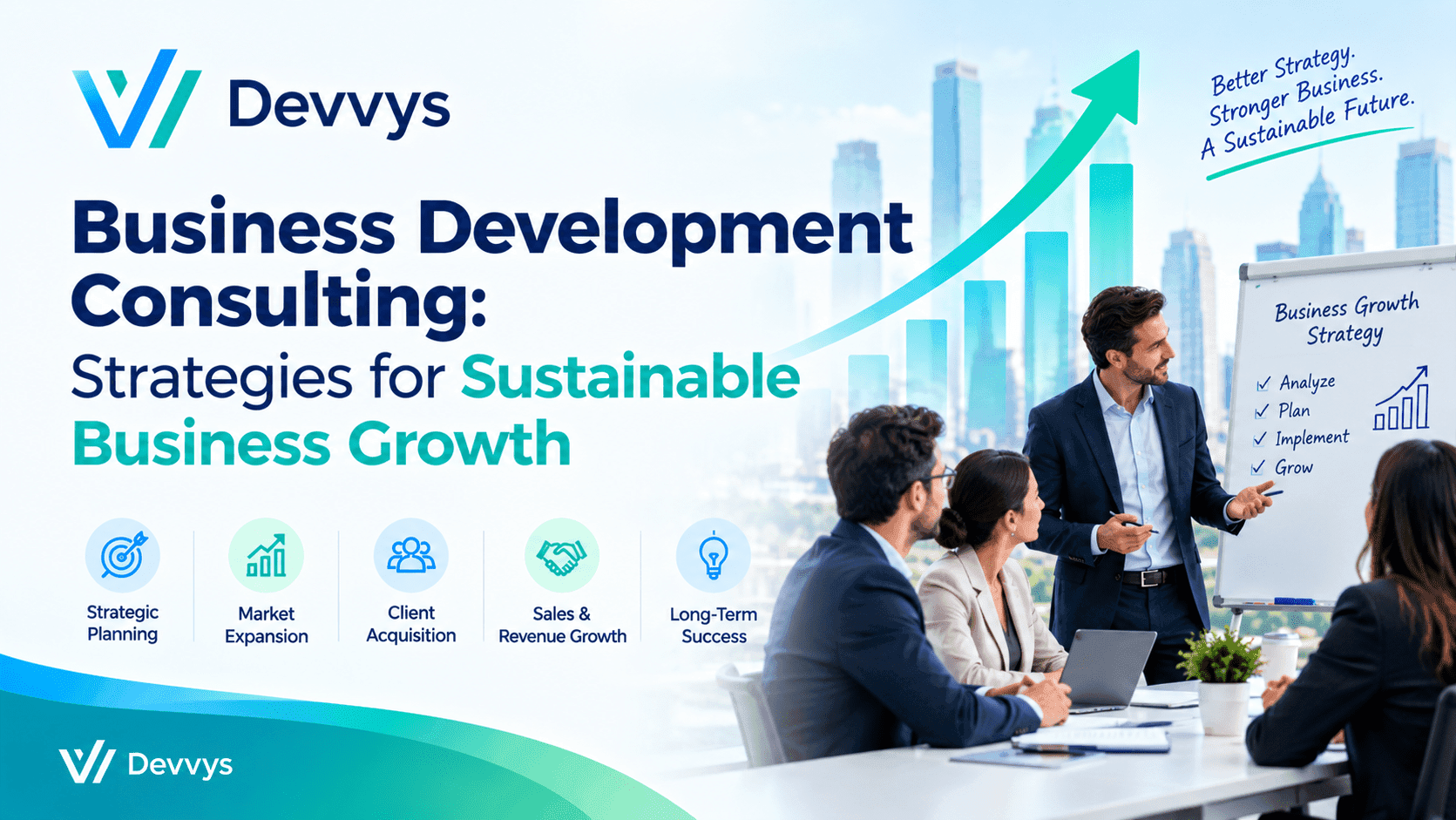
Business Development Consulting: Strategies for Sustainable Business Growth
Introduction: Why Business Development Consulting Is Critical for Sustainable Growth
In an era of rapid market changes, evolving customer expectations, and intensifying competition, sustainable business growth requires more than just a great product or service. It demands a strategic, systematic approach to identifying opportunities, building relationships, and driving revenue—this is where business development consulting becomes invaluable.
Business development consulting has evolved from a nice-to-have advisory service into a strategic imperative for companies that want to scale sustainably. Unlike traditional consulting that focuses on broad strategy or operations, business development consulting zeroes in on the specific activities, processes, and strategies that directly drive revenue growth, market expansion, and long-term value creation.
In this comprehensive guide, we'll explore everything you need to know about business development consulting, including what it entails, key strategies for sustainable growth, specific consulting services you should consider, how to measure success, implementation best practices, and how to choose the right consultant for your business. Whether you're a startup founder, a growth-stage CEO, or an executive at an established company, this guide will equip you with the knowledge to leverage business development consulting for sustainable growth.
What Is Business Development Consulting?
Defining Business Development Consulting
Business development consulting is a specialized advisory service that helps companies identify, create, and capture growth opportunities through strategic initiatives. Business development consultants work with leadership teams to design and implement growth strategies, optimize sales and marketing processes, build strategic partnerships, and establish scalable systems for sustainable revenue growth.
Unlike general management consultants who may focus on broad organizational strategy or operational efficiency, business development consultants specialize in:
Revenue Growth Strategy: Designing pathways to increase top-line revenue
Market Expansion: Identifying and entering new markets, segments, or geographies
Lead Generation and Sales Optimization: Building pipelines and improving conversion rates
Strategic Partnerships: Creating alliances and channels that accelerate growth
Customer Retention and Expansion: Maximizing lifetime value from existing customers
Go-to-Market (GTM) Strategy: Launching products or entering markets effectively
Revenue Operations: Aligning sales, marketing, and customer success for optimal performance
Business Development Consulting vs. Other Consulting Services
It's important to distinguish business development consulting from related consulting disciplines:
Business Development Consulting:
Focus: Revenue growth, market expansion, partnerships, sales optimization
Outcomes: Increased revenue, pipeline growth, new markets, strategic deals
Engagement: Strategic advisory + hands-on implementation support
Measurement: Revenue metrics, pipeline KPIs, market share, partnership ROI
Management Consulting:
Focus: Overall business strategy, operations, organizational design
Outcomes: Strategic clarity, operational efficiency, organizational effectiveness
Engagement: High-level strategy and transformation programs
Measurement: Strategic milestones, operational KPIs, ROI on initiatives
Marketing Consulting:
Focus: Brand, demand generation, marketing strategy and execution
Outcomes: Brand awareness, lead volume, marketing ROI
Engagement: Marketing strategy, campaigns, channel optimization
Measurement: Leads, traffic, engagement, conversion rates, CAC
Sales Consulting:
Focus: Sales team performance, process, and closing deals
Outcomes: Sales quotas, win rates, deal velocity
Engagement: Sales training, process design, coaching
Measurement: Revenue closed, win rates, sales cycle length
Business development consulting uniquely combines strategic thinking with practical execution across the entire revenue engine.
Key Business Development Consulting Services for Sustainable Growth
1. Growth Strategy Development
The foundation of sustainable growth is a clear, actionable growth strategy. Consulting services include:
Strategic Growth Planning
Assessment of current growth trajectory and gaps
Market opportunity sizing and prioritization
Growth model design (organic, inorganic, partnerships)
Revenue targets and milestone planning
Resource allocation and investment priorities
Market Entry and Expansion Strategy
New market evaluation and selection (geographic, vertical, segment)
Market entry mode analysis (direct, partners, acquisitions)
Competitive positioning and differentiation strategy
Go-to-market (GTM) strategy design
Launch planning and execution roadmaps
Business Model Innovation
Business model assessment and optimization
Revenue stream diversification strategies
Pricing strategy and monetization models
Product-market fit validation and refinement
Scalability and unit economics analysis
Deliverables: Growth strategy documents, market analysis reports, GTM plans, business model frameworks, financial projections
2. Market Research and Competitive Intelligence
Understanding your market is critical for informed decision-making. Services include:
Market Analysis
Market size, growth rates, and trends
Industry dynamics and regulatory landscape
Customer segmentation and sizing
Market attractiveness and opportunity scoring
Competitive Intelligence
Competitor mapping and profiling
Competitive positioning and strategy analysis
Pricing benchmarking and comparison
Strengths, weaknesses, and gap analysis
Market share and competitive dynamics
Customer Insights
Target customer personas and journey mapping
Customer pain points, needs, and buying criteria
Voice of customer research (interviews, surveys, feedback)
Customer satisfaction and loyalty analysis
Product-market fit assessment
Deliverables: Market research reports, competitive intelligence briefs, customer personas, opportunity assessments, strategic recommendations
3. Lead Generation and Sales Pipeline Development
Building a robust, predictable pipeline is essential for sustainable growth. Consulting services include:
Lead Generation Strategy
Ideal customer profile (ICP) definition and refinement
Lead sourcing strategies (inbound, outbound, partnerships)
Channel strategy and prioritization (content, paid, events, etc.)
Lead magnet and offer development
Marketing and sales alignment for lead handoff
Sales Process Optimization
Sales funnel design and stage definitions
Qualification criteria and lead scoring models
Sales playbooks, scripts, and battle cards
Objection handling and closing frameworks
Sales cadence and activity standards
Pipeline Management
Pipeline health assessment and gap analysis
Forecasting models and accuracy improvement
Pipeline velocity optimization
Conversion rate analysis and improvement
CRM best practices and utilization
Deliverables: Lead generation strategies, sales playbooks, pipeline dashboards, forecasting models, conversion optimization plans
4. Strategic Partnerships and Alliance Development
Partnerships can accelerate growth by leveraging complementary strengths. Consulting services include:
Partnership Strategy
Ecosystem mapping and partner identification
Partner fit analysis and prioritization framework
Partnership model selection (reseller, referral, integration, co-marketing, OEM)
Partner value proposition development
Partnership roadmap and prioritization
Partner Recruitment and Onboarding
Partner outreach and courtship strategies
Partnership proposal and agreement development
Partner selection and due diligence
Partner onboarding and enablement programs
Partner training and certification
Partner Management and Optimization
Partner performance tracking and metrics
Co-marketing campaign development and execution
Partner relationship management and communication
Partner incentive and motivation programs
Partner program optimization and iteration
Deliverables: Partnership strategies, partner agreements, enablement materials, performance dashboards, co-marketing plans
5. Customer Retention and Expansion Strategy
Retaining and expanding existing customers is often more cost-effective than acquiring new ones. Services include:
Customer Success Strategy
Customer onboarding process design
Customer health scoring and monitoring
Success planning and goal setting frameworks
Early warning systems for at-risk customers
Customer feedback loops and action plans
Account Expansion Strategy
Upsell and cross-sell opportunity identification
Account mapping and stakeholder engagement
Expansion playbooks and scripts
Pricing and packaging for expansion
Renewal management and retention strategies
Customer Advocacy Programs
Net Promoter Score (NPS) and CSAT programs
Customer reference and case study development
Referral program design and execution
Customer advisory boards and feedback forums
Community building and engagement
Deliverables: Customer success playbooks, expansion strategies, retention metrics, advocacy programs, NPS/CSAT frameworks
6. Revenue Operations (RevOps) Consulting
Revenue operations aligns sales, marketing, and customer success for optimal performance. Services include:
Process Alignment and Optimization
End-to-end revenue process mapping
Handoff optimization between teams (marketing to sales, sales to CS)
SLA definitions and accountability frameworks
Cross-functional collaboration and communication cadences
Process documentation and standardization
Data, Analytics, and Forecasting
Unified data architecture and integration strategy
Revenue dashboards, KPIs, and reporting frameworks
Forecasting models and accuracy improvement
Attribution and ROI analysis
Data governance and hygiene standards
Technology Stack Optimization
Martech and sales tech stack audit and recommendations
Tool selection, consolidation, and integration
Automation and workflow optimization
Change management and adoption support
ROI analysis and business case development
Deliverables: RevOps frameworks, process documentation, dashboards, tech stack recommendations, automation roadmaps
Strategies for Sustainable Business Growth
1. Embrace Data-Driven Decision Making
Sustainable growth is powered by data. Business development consulting helps you:
Implement analytics and reporting systems for visibility
Define and track key growth metrics and KPIs
Use data to identify high-value opportunities and prioritize efforts
Test and iterate on strategies based on measurable results
Forecast revenue and plan resources with accuracy
Implementation Steps:
Audit current data and analytics capabilities
Define critical metrics and KPIs for your business
Implement or optimize CRM, marketing automation, and analytics tools
Create dashboards for real-time visibility
Establish regular performance review cadences
2. Focus on Customer-Centric Growth
Customer-centricity is a competitive necessity. Business development consulting helps you:
Develop deep understanding of customer pain points and needs
Design personalized experiences at every touchpoint
Implement proactive customer success and support
Build feedback loops for continuous improvement
Align all growth activities with customer value creation
Implementation Steps:
Conduct customer research and develop detailed personas
Map customer journeys and identify friction points
Implement customer feedback systems (surveys, NPS, interviews)
Align business development activities with customer outcomes
Measure and optimize customer satisfaction and loyalty
3. Diversify Growth Channels
Relying on a single growth channel is risky. Sustainable growth requires diversification:
Build a balanced mix of inbound and outbound lead generation
Develop strategic partnerships for referral and channel revenue
Explore new markets, segments, or geographies
Invest in content marketing and thought leadership
Experiment with emerging channels and tactics
Implementation Steps:
Audit current channel performance and ROI
Identify and prioritize new channel opportunities
Develop channel-specific strategies and playbooks
Allocate resources across channels based on potential and performance
Continuously test and optimize channel mix
4. Build Strategic Ecosystems and Partnerships
No business succeeds in isolation. Ecosystems drive growth:
Identify complementary businesses for strategic partnerships
Develop channel partner programs for distribution
Build integration partnerships for product ecosystems
Co-market with partners to expand reach
Leverage partner networks for referrals and introductions
Implementation Steps:
Map your ecosystem and identify partnership opportunities
Develop compelling partnership value propositions
Create partner enablement materials and programs
Establish partner performance metrics and incentives
Track, optimize, and scale successful partnerships
5. Invest in Scalable Systems and Processes
Sustainable growth requires scalability. Business development consulting helps you:
Design repeatable, scalable sales and marketing processes
Implement technology and automation for efficiency
Build playbooks and documentation for consistency
Train and enable teams for execution excellence
Establish metrics and accountability for performance
Implementation Steps:
Document current processes and identify gaps
Design scalable processes with clear stages and criteria
Implement CRM, automation, and enablement tools
Create playbooks, templates, and training materials
Establish performance metrics and regular reviews
6. Prioritize Agility and Continuous Improvement
The business landscape is dynamic. Stay agile by:
Testing and iterating on strategies quickly
Pivoting based on market feedback and data
Embracing experimentation and learning from failures
Building flexible processes that can scale
Staying informed on industry trends and disruptions
Implementation Steps:
Implement agile methodologies in business development
Conduct regular strategy reviews and adjustments (quarterly or monthly)
Encourage experimentation with defined hypotheses and metrics
Create feedback loops from customers, market, and teams
Stay connected to industry signals and competitive moves
How to Measure Business Development Consulting Success
Key Metrics and KPIs
To ensure your business development consulting investment delivers results, track these metrics:
Revenue Metrics
Revenue growth (month-over-month, year-over-year)
Revenue by channel, segment, or product
Average deal size and lifetime value (LTV)
Customer acquisition cost (CAC) and LTV:CAC ratio
Pipeline Metrics
Pipeline value and growth rate
Pipeline velocity (time from lead to close)
Conversion rates by stage
Win rate and loss reasons
Market Metrics
Market share and penetration
New market entry success (revenue, customers, partnerships)
Brand awareness and consideration (if applicable)
Competitive positioning improvements
Customer Metrics
Customer retention rate and churn
Net Promoter Score (NPS) and CSAT
Expansion revenue (upsells, cross-sells)
Customer references and advocacy
Efficiency Metrics
Sales cycle length
Revenue per employee
ROI of business development activities
Payback period on customer acquisition
Reporting and Accountability
Establish clear reporting and accountability structures:
Weekly: Pipeline reviews, activity metrics, immediate blockers
Monthly: Revenue performance, KPI tracking, tactical adjustments
Quarterly: Strategic reviews, goal progress, resource reallocation
Annually: Year-end performance, strategic planning, budget allocation
Best Practices for Implementing Business Development Consulting
1. Start with Clear Objectives and Alignment
Before engaging a consultant, ensure clarity:
Define specific, measurable growth objectives
Align leadership team on priorities and expectations
Identify key challenges and opportunities to address
Establish success criteria and KPIs upfront
Document scope, deliverables, and timelines in a statement of work (SOW)
2. Choose the Right Consultant for Your Needs
Not all consultants are created equal. Look for:
Relevant industry experience and track record
Expertise in your specific growth challenges
Proven methodologies and frameworks
Strong references and case studies
Cultural fit and communication style alignment
3. Provide Access and Context
Enable your consultant to succeed:
Share relevant data, insights, and context about your business
Provide access to key stakeholders and decision-makers
Be transparent about challenges, constraints, and priorities
Involve them in strategic discussions and planning sessions
4. Stay Engaged and Committed
This is a partnership, not a hands-off engagement:
Assign an internal owner or point of contact
Participate actively in strategy sessions and reviews
Provide timely feedback and make decisions promptly
Hold both sides accountable for commitments and deliverables
5. Focus on Implementation, Not Just Strategy
Strategy without execution is worthless. Ensure:
Consulting engagements include implementation support, not just recommendations
Clear action plans with owners, timelines, and milestones
Regular check-ins to track progress and address blockers
Accountability for execution and results, not just deliverables
6. Think Long-Term and Be Patient
Sustainable growth takes time:
Expect 3-6 months to see initial traction from new strategies
Allow 6-12 months for meaningful pipeline and revenue impact
Avoid pivoting strategies too quickly based on short-term results
Invest in building sustainable growth engines, not quick fixes
7. Measure, Learn, and Optimize
Continuous improvement drives better results:
Track agreed-upon KPIs and metrics consistently
Review performance data regularly with your consultant
Identify what's working and double down on those efforts
Pivot or stop what's not delivering results
Iterate and optimize based on data and feedback
Business Development Consulting: FAQs
What is business development consulting?
Business development consulting is a specialized advisory service that helps companies identify, create, and capture growth opportunities through strategic initiatives. Consultants work with leadership teams to design and implement growth strategies, optimize sales and marketing processes, build partnerships, and establish scalable systems for sustainable revenue growth.
How is business development consulting different from management consulting?
Management consulting focuses on broad business strategy, operations, and organizational design. Business development consulting specializes specifically in revenue growth, market expansion, partnerships, sales optimization, and customer retention—directly tied to top-line growth.
What services do business development consultants provide?
Services include growth strategy development, market research, lead generation strategy, sales optimization, strategic partnerships, customer retention and expansion, go-to-market strategy, and revenue operations. Specific services depend on your needs and the consultant's expertise.
How much does business development consulting cost?
Costs vary widely based on scope, consultant experience, and engagement model. Typical ranges: hourly rates ($150–$500+), monthly retainers ($5,000–$50,000+), or project-based fees ($10,000–$150,000+). Performance-based models may include success fees or revenue sharing.
How long does it take to see results from business development consulting?
Business development consulting is a medium to long-term investment. Expect 3-6 months to see initial traction from new strategies, 6-12 months for meaningful pipeline and revenue impact, and 12-24 months for transformational growth. Patience and consistent execution are key.
Should I hire a business development consultant or build an in-house team?
It depends on your stage, resources, and needs. Consultants offer expertise, objectivity, and flexibility without long-term commitment. In-house teams provide continuity and institutional knowledge. Many companies start with consultants to establish strategy and systems, then build in-house capabilities as they scale.
What industries do business development consultants serve?
Business development consultants serve diverse industries including technology/SaaS, healthcare, financial services, professional services, manufacturing, consumer products, and more. Look for consultants with experience in your industry or adjacent markets for maximum impact.
How do I measure ROI from business development consulting?
Track metrics such as revenue growth, pipeline generated, deals closed, partnerships established, customer acquisition cost (CAC), lifetime value (LTV), and LTV:CAC ratio. Compare these outcomes against your consulting investment to calculate ROI. Also consider qualitative benefits like strategic clarity, process improvements, and team capabilities.
Conclusion: Ready to Achieve Sustainable Business Growth with Business Development Consulting?
In today's competitive landscape, business development consulting is no longer a luxury—it's a strategic necessity for companies that want to achieve sustainable, scalable growth. While it requires an investment, the returns—accelerated revenue growth, market expansion, strategic partnerships, optimized sales processes, and customer retention—make it one of the highest-ROI investments you can make.
The companies that thrive will be those that embrace data-driven strategies, prioritize customer-centric growth, diversify channels, build ecosystems, invest in scalable systems, and remain agile. Business development consulting provides the expertise, frameworks, and accountability to make this happen.
Whether you're a startup seeking product-market fit and initial traction, a growth-stage company looking to scale efficiently, or an established business pursuing new markets or transformations, business development consulting gives you the strategic guidance and practical support to achieve sustainable growth.