
AI for Real Estate: 9 repetitive Tasks You Can Automate Today
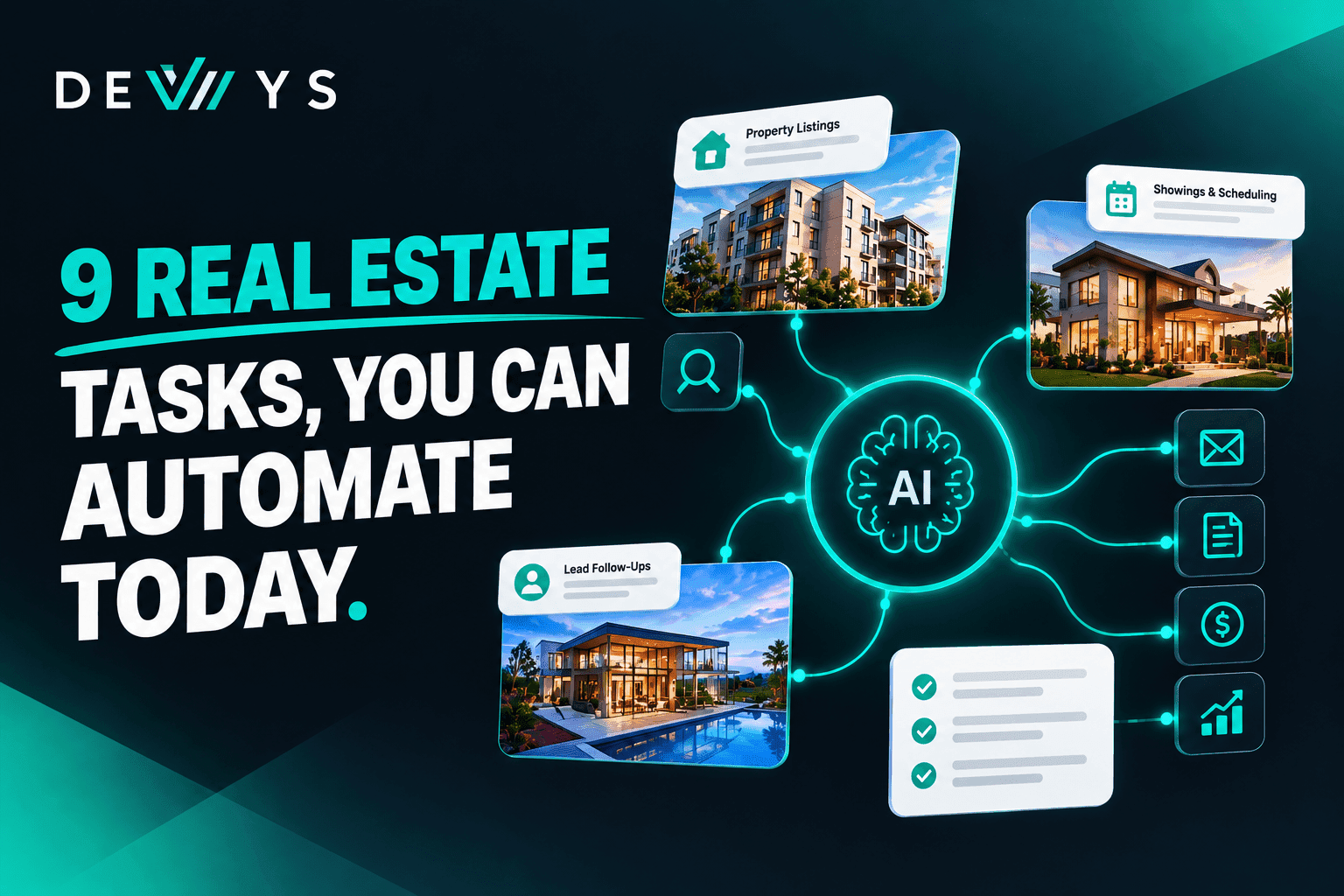
AI automation for property management helps residential communities, hotels, and short-term rental businesses reduce repetitive administrative work. From answering inquiries and scheduling tours to creating maintenance tickets and sending guest messages, AI agents and workflow automation can keep daily operations moving with less manual effort.
Property management involves a constant flow of leads, appointments, resident questions, maintenance requests, payments, renewals, and follow-ups. Whether you manage apartments, operate a hotel, or oversee vacation rentals, these recurring tasks can consume hours of staff time every day.
AI for property management offers a practical solution. With custom AI agents and connected workflows, property businesses can respond to inquiries 24/7, coordinate maintenance, manage routine communication, and organize operations without replacing their entire technology stack.
At Devvys, we build AI-driven software and property management workflow automation designed around each business’s needs. By connecting AI agents with property management systems (PMS), CRMs, booking platforms, calendars, and communication channels, teams can automate routine work while keeping people in control of important decisions.
In this guide, we’ll cover nine property management tasks you can automate across three areas: residential housing, hotels, and short-term rentals.
Why AI Automation Matters in Property Management
Property management automation uses software, integrations, and AI-assisted workflows to complete repetitive tasks with minimal manual input. Common examples include rent reminders, maintenance request routing, tour scheduling, guest messaging, and lease renewal notifications.buildium+1
AI goes a step further by understanding messages, classifying requests, retrieving approved information, drafting responses, and triggering next steps. In practice, the strongest results come from combining automation for repeatable rules with AI for communication, triage, and decision support.buildium+1
AI works best when it handles bounded, high-volume work—such as answering common questions, extracting details, routing tasks, and flagging exceptions—while staff handle approvals, negotiations, complaints, and sensitive decisions.mrisoftware+1
AI Automation for Residential Housing
Residential property management includes multifamily buildings, single-family rentals, and other rental housing. Leasing teams and property managers must handle prospective tenants, schedule tours, answer resident questions, coordinate repairs, collect rent, and manage lease renewals.
AI agents for property management can reduce manual work while making resident and prospect communication faster and more consistent.
1. Automate Property Tour Scheduling and Lead Follow-Ups
The traditional process
When someone expresses interest in a rental, a leasing agent usually needs to answer questions, check availability, coordinate schedules, and confirm a tour. This often requires multiple calls, emails, and text messages.
If an inquiry arrives after business hours, the prospect may wait until the next day for a response. By then, they may have contacted another property.
Staff also spend time sending confirmations, reminding prospects about upcoming tours, and following up with no-shows or people who never book a visit.
How AI automation helps
A custom AI leasing assistant can manage much of this process automatically:
Respond to new leads 24/7 with relevant property information.
Ask qualifying questions to understand the prospect’s needs.
Connect with an approved calendar or scheduling system to offer available tour times.
Book appointments and send confirmations automatically.
Send reminders before scheduled property tours.
Follow up with interested prospects who have not booked a visit.
Re-engage no-shows and offer another available time.
Escalate complex questions to a leasing agent with full conversation context.
For example, a prospective tenant may ask whether a two-bedroom apartment is available and request a viewing. The AI assistant can retrieve property details, offer available appointment slots, book the selected time, and send a confirmation—without staff handling every message manually.
Business impact: Faster lead response, fewer missed opportunities, less scheduling work, and a more organized leasing process.
2. Automate Resident Inquiries and Maintenance Requests
The traditional process
Property managers receive ongoing questions about rent payments, building rules, amenities, parking, access, and resident services.
Maintenance adds another layer of work. When a resident reports a leaking faucet, broken appliance, or electrical issue, staff may need to collect details, create a work order, identify the right technician, coordinate an appointment, and update the resident.
After-hours requests can be especially difficult. Important issues may sit in a voicemail inbox or remain unanswered until the next working day.
How AI automation helps
An AI resident support agent can answer common questions and manage maintenance requests through approved channels such as website chat, email, SMS, and phone calls.
Provide instant answers using an approved knowledge base.
Identify repair requests in resident messages.
Create maintenance tickets or work orders in the connected property management system.
Classify issues by type, such as plumbing, electrical, appliance, or access problems.
Prioritize urgent requests based on predefined rules.
Route tasks to the correct technician, vendor, or property manager.
Coordinate maintenance appointments and send confirmations.
Escalate complaints, emergencies, and complex issues with conversation history.
For example, if a resident messages, “My kitchen faucet is leaking,” the AI can recognize the maintenance request, collect required details, create a work order, categorize the issue, and notify the appropriate team.
For urgent situations, the workflow can immediately notify on-call staff according to the property’s escalation rules.
Business impact: Faster responses, more organized maintenance operations, fewer missed requests, and better visibility into outstanding work.
3. Automate Rent Collection Reminders and Lease Renewals
The traditional process
Rent collection and lease renewals require careful tracking and regular communication.
Property managers often send reminders before rent is due, follow up on overdue accounts, track lease expirations, and contact residents about renewal options. For portfolios with hundreds or thousands of units, manually tracking every deadline becomes difficult.
How AI automation helps
By connecting an AI agent to the property management system, calendar, and approved communication tools, businesses can automate routine rent and renewal workflows.
Send upcoming rent reminders before the due date.
Follow up when a payment has not been recorded.
Track leases approaching expiration.
Start renewal communication 60 or 90 days in advance, based on policy.
Answer common renewal questions.
Direct residents to the correct portal or renewal form.
Send approved follow-up messages when residents do not respond.
Alert property managers when a resident raises a concern or needs special assistance.
For example, the system can identify a lease expiring in 90 days, send a renewal message, and provide instructions for reviewing available options. If the resident asks about pricing or special terms, the AI can route the conversation to a property manager.
Payment status and lease data should always come from the connected system rather than being guessed by the AI. Sensitive decisions and exceptions should remain under human control.
Business impact: Fewer missed deadlines, more consistent communication, reduced administrative work, and better organization of rent and renewal workflows.
AI Automation for Hotels
Hotels operate in a service environment where response time and guest experience matter. Teams must answer booking questions, communicate with upcoming guests, manage in-stay requests, and coordinate additional services.
AI property management software can support these activities across website chat, messaging apps, email, and phone calls, while allowing hotel staff to focus on high-value guest interactions.
4. Automate Hotel Booking Inquiries Around the Clock
The traditional process
Hotels receive questions about room availability, nightly rates, amenities, cancellation policies, and special requests throughout the day.
Smaller hotels may rely on voicemail outside business hours, while busy front desks may struggle to respond quickly. A potential guest who does not receive an answer may book with a competing hotel.
How AI automation helps
An AI booking assistant can respond immediately and retrieve accurate information from a connected reservation or property management system.
Check real-time room availability and rates.
Answer approved FAQs about amenities, check-in times, pets, parking, and cancellation rules.
Recommend suitable room types or packages.
Guide guests through the booking process.
Help create reservations where the connected system supports it.
Use Voice AI to answer calls, handle routine questions, and collect booking details.
Transfer complex requests or payment steps to hotel staff.
For example, a guest may ask, “Do you have a suite available this Friday?” The AI can check the reservation system and respond with available options and current rates. If the guest mentions an anniversary, the assistant can suggest relevant packages or upgrades if offered.
When reservation or payment steps require verification, the AI can direct the guest to the approved booking process or connect them with staff.
Business impact: Faster inquiry handling, fewer missed booking opportunities, better after-hours guest support, and reduced pressure on front-desk teams.
5. Automate Guest Communications and Reminders
The traditional process
A smooth hotel experience depends on communication before, during, and after a guest’s stay.
Hotels may send booking confirmations, pre-arrival emails, check-in instructions, reminders, and post-checkout messages. Staff may also need to monitor replies and handle arrival changes or special requests.
Managing these communications manually becomes time-consuming when a hotel handles many reservations at once.
How AI automation helps
An AI-powered communication workflow can send scheduled messages based on reservation details and respond to routine guest replies.
Send personalized pre-arrival messages.
Share check-in times, directions, and arrival instructions.
Receive and process guest replies through supported messaging channels.
Check hotel rules and availability before handling early check-in requests.
Ask during-stay check-in questions and route requests to the right team.
Send post-checkout thank-you messages.
Invite guests to leave a review or book another stay.
For example, the system could send a message the day before arrival:
“Hi [Guest Name], your stay begins tomorrow, and check-in starts at 3 PM. Please let us know if you have any questions or special requests.”
If the guest asks to arrive at 1 PM, the AI can check the hotel’s early check-in policy and available options. If approval is required, it can forward the request to the front desk instead of promising something that has not been confirmed.
Business impact: More consistent guest communication, fewer repetitive calls, and a smoother guest journey from booking to checkout.
6. Automate Digital Concierge Services, Guest Requests, and Upsells
The traditional process
During a hotel stay, guests may contact the front desk for extra towels, pillows, housekeeping, maintenance, restaurant information, or other services.
During busy periods, requests can take longer to process. Staff may also miss opportunities to offer relevant extras, such as room upgrades, spa appointments, or late checkout.
How AI automation helps
An AI concierge for hotels gives guests an easy way to request services through chat or messaging, while connecting requests to operational workflows.
Answer questions about facilities, dining, service hours, and hotel policies.
Create housekeeping tasks for towels, pillows, blankets, or room cleaning.
Record maintenance issues and route them to the appropriate team.
Track request status and send updates when supported by connected systems.
Suggest relevant upsells, such as room upgrades, spa bookings, or late checkout.
Support reservation and payment workflows through approved systems.
For example, a guest may message, “Could I get two extra pillows and a blanket?” The AI concierge can acknowledge the request, create a housekeeping task, and notify the relevant team.
The same assistant could suggest late checkout when the guest’s booking, hotel policy, and availability make it suitable.
Business impact: Faster service requests, better coordination between departments, improved guest convenience, and additional revenue opportunities.
AI Automation for Short-Term Rentals
Short-term rental businesses, including vacation homes and Airbnb-style properties, face different operational challenges.
Managers may oversee properties across several locations without on-site staff. They need to coordinate guest communication, booking details, cleaning schedules, check-ins, checkouts, and maintenance between stays.
As the portfolio grows, short-term rental automation becomes essential for maintaining consistent service across every property.
7. Automate Guest Support Across Multiple Channels
The traditional process
Short-term rental managers communicate with guests through Airbnb, Vrbo, direct booking websites, email, SMS, WhatsApp, and phone calls.
During busy seasons, questions about Wi-Fi, parking, check-in instructions, house rules, amenities, and booking details can overwhelm a small team.
Answering the same questions repeatedly takes time, while delayed responses can hurt the guest experience.
How AI automation helps
An AI guest support agent can bring supported communication channels into a more organized workflow and provide property-specific answers around the clock.
Centralize guest communication from supported channels.
Use approved property-specific knowledge, including house manuals and check-in details.
Answer common questions instantly.
Provide booking and pricing information when connected to an accurate reservation source.
Collect required guest information according to host policies.
Keep conversation records available for authorized managers.
Escalate unresolved issues with relevant context.
For example, a guest messaging through a supported booking channel may ask for the Wi-Fi password. The AI retrieves the correct information for that specific property and responds immediately.
If the guest reports a problem that cannot be resolved through the approved knowledge base, the AI can send the conversation to the property manager with the relevant details.
Access codes and other sensitive information should only be shared with authorized guests at the appropriate time.
Business impact: Faster guest responses, less repetitive communication, more consistent support across properties, and better visibility into guest interactions.
8. Automate Check-In, Checkout, and Scheduled Guest Messages
The traditional process
Short-term rental management involves sending a sequence of messages for every reservation: booking confirmations, arrival instructions, welcome messages, checkout reminders, and post-stay follow-ups.
Many hosts use templates or channel management tools, but these workflows may still require manual setup and intervention when dates change or guests ask questions.
How AI automation helps
AI-driven workflows can trigger communications based on reservation events and personalize messages using booking information.
Start the communication sequence when a reservation is confirmed.
Send pre-arrival reminders with essential stay details.
Deliver approved check-in directions and access instructions.
Check in with guests during their stay.
Send checkout reminders based on property rules.
Send post-stay thank-you messages and review requests.
Respond to routine questions after scheduled messages.
Update or reschedule messages when reservation details change.
For example, three days before arrival, the system could send:
“Hi [Guest Name], we’re getting your rental ready for your stay! Your check-in is on Friday after 3 PM. We’ll send your arrival instructions before check-in. Feel free to message us if you have any questions.”
On check-in day, the guest receives approved directions and entry instructions. After checkout, the AI can send a thank-you message and invite the guest to leave a review.
If reservation dates change, the workflow should use updated booking information instead of continuing with the original schedule.
Business impact: Fewer manual messages, more reliable guest communication, fewer scheduling mistakes, and a more consistent experience across every reservation.
9. Automate Maintenance and Property Operations
The traditional process
Short-term rental operations require coordination between guests, cleaners, inspectors, maintenance technicians, and property managers.
When something breaks, a guest may contact the host, who then needs to understand the issue, contact a technician, create a task, and arrange repairs.
Problems can also be discovered after checkout. A cleaner may report a stained sofa, broken appliance, or damaged fixture, leaving the manager to record the issue and arrange repairs before the next guest arrives.
How AI automation helps
AI can identify operational issues in messages and trigger the appropriate workflow, helping property managers coordinate maintenance and turnover activities.
Detect maintenance problems in guest messages, cleaner reports, or inspection notes.
Create maintenance tickets with property, issue, and conversation details.
Categorize issues such as internet, plumbing, furniture damage, or electrical faults.
Flag urgent issues according to predefined priority rules.
Notify the appropriate staff or vendor.
Turn housekeeping and inspection reports into actionable tasks.
Track task status from new to assigned, in progress, and completed.
Send updates to guests or managers when appropriate.
For example, a guest may message: “The Wi-Fi is down, and I really need it for work.” The AI can acknowledge the issue, provide approved troubleshooting steps, create an internet issue ticket, notify the support contact, and flag the issue based on priority rules.
Similarly, if a cleaner reports a stained sofa in Unit 5, the system can create a cleaning or repair task and notify the right team before the next arrival.
Business impact: Faster issue detection, fewer forgotten maintenance tasks, better team coordination, and more reliable property turnover.
How to Get Started with AI Automation for Real Estate
You do not need to automate every property management task at once. Start with one workflow that creates a clear operational benefit, measure the results, and expand from there.
Step 1: Identify Your Most Repetitive Tasks
Review how your team spends time each week. Look for recurring work such as answering the same questions, sending reminders, scheduling appointments, following up with leads, and creating maintenance tickets.
Prioritize tasks that are frequent, time-consuming, and follow predictable rules.
Step 2: Choose the Right AI Automation
Different tasks require different solutions:
AI chat agents answer questions and support website visitors or guests.
AI voice agents answer calls, collect information, and handle routine conversations.
Workflow automation sends reminders, creates tasks, updates records, and notifies staff.
Integrated AI agents combine conversation, information retrieval, and approved actions across connected systems.
The right approach depends on the workflow, existing systems, and the level of human oversight required.
Step 3: Connect Your Existing Systems
AI automation becomes more useful when it works with the systems that already hold your business information.
Depending on the workflow, this may include a property management system, CRM, reservation platform, calendar, email service, messaging app, or maintenance management tool.
Before implementation, confirm that the required APIs, permissions, and data access are available.
Step 4: Define Rules and Human Escalation
AI should not make promises based on incomplete information or take actions outside its authority.
Define which tasks the AI can complete independently and which require approval. For example, an AI assistant may answer questions about amenities, but a manager may need to approve a special rent arrangement, refund, room upgrade, or unusual maintenance expense.
Access permissions, privacy safeguards, audit records, and escalation rules should be part of the workflow design.
Step 5: Measure the Results
Track a small set of useful metrics before and after implementation:
Average response time to new inquiries
Number of leads receiving timely follow-ups
Staff hours spent on repetitive tasks
Maintenance request response and completion times
Missed appointments or follow-ups
Booking conversion and renewal rates
Guest satisfaction and review trends
These measurements show whether property management workflow automation is delivering value and where further improvements are needed.
Build Smarter Property Management Workflows with Devvys
Managing residential properties, hotels, or short-term rentals involves more than keeping properties occupied. Teams must respond quickly, coordinate service requests, manage deadlines, and keep information accurate across multiple systems.
AI automation for property management can reduce the manual workload behind these activities.
From AI leasing assistants and resident support agents to hotel concierges and short-term rental operations workflows, automation opportunities extend across the entire property management process.
Devvys helps businesses turn repetitive processes into practical, AI-driven workflows. We build custom software, AI agents, voice automation, and system integrations around the way your business operates.
Whether you want to automate incoming calls, follow up with property leads, organize maintenance requests, or streamline guest communication, the first step is to identify a workflow where automation can make a measurable difference.